elias
When you walk into a school building, the story of resource allocation is written in the details. It shows up in the condition of the science lab equipment, the ratio of students to counselors, and whether the library has enough copies of the class novel for every student. For school administrators, district finance officers, and equity coordinators, these details are not just logistics. They are signals about who matters and who gets left behind. An equity audit of school resource allocation is the most direct way to read those signals and act on them.
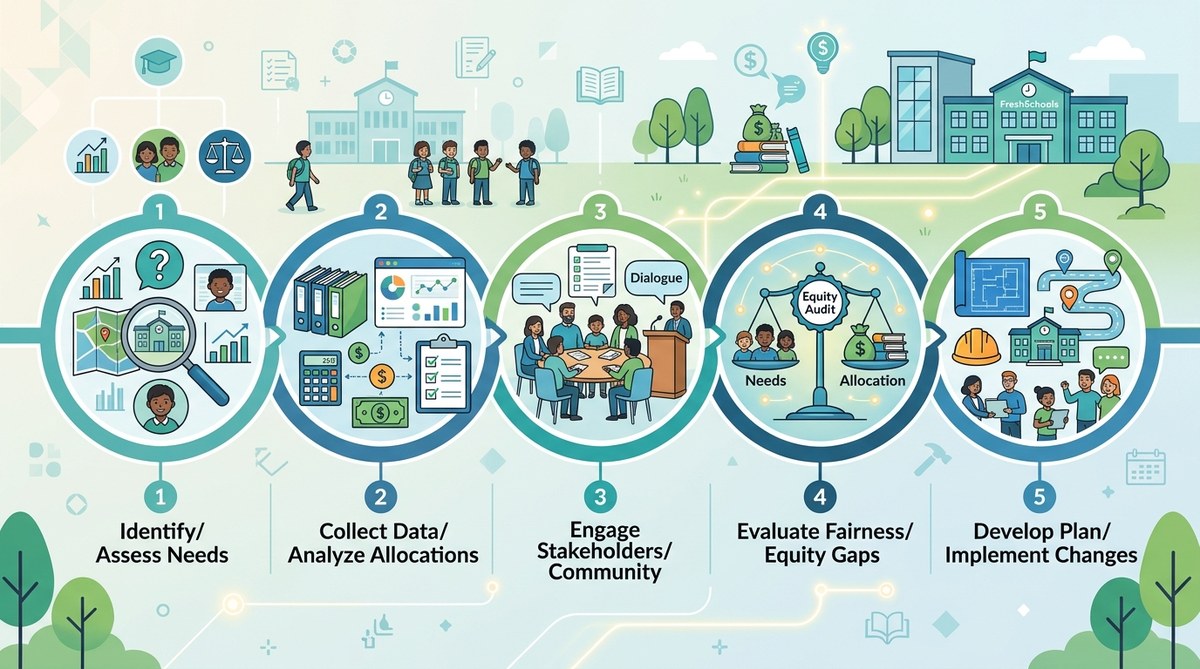
An equity audit is a structured process that reveals how fairly your school or district distributes funding, staff quality, instructional materials, and facilities. The five steps are: define your equity lens, gather data across resource categories, analyze disparities with stakeholder input, prioritize corrective actions, and monitor progress over time. This framework turns good intentions into measurable change.
What an Equity Audit Actually Measures
An equity audit is not a one-time report card. It is a diagnostic tool that compares resource levels across different schools, grade bands, or demographic groups within your system. The goal is to spot patterns where students from low-income families, students of color, English learners, or students with disabilities receive less than their peers.
The audit looks at four main categories of resources:
- Financial resources: Per-pupil spending, Title I funds, local levy dollars, and grant distribution
- Human resources: Teacher experience, certification levels, turnover rates, and access to specialized staff like counselors and nurses
- Programmatic resources: Access to advanced coursework, arts programs, early childhood education, and intervention services
- Physical resources: Building age, technology infrastructure, classroom materials, and playground or athletic facilities
Each category tells part of the story. Taken together, they reveal systemic imbalances that no single budget adjustment can fix.
The 5-Step Process for Conducting an Equity Audit
Here is the practical sequence that works for districts of any size. You can adapt the timeline based on your capacity, but the order matters.
1. Define Your Equity Lens and Scope
Before you pull a single spreadsheet, your team needs to agree on what equity means for this audit. Are you comparing schools within the same district? Are you looking at resource allocation by race, by free and reduced-price lunch status, or by special education classification?
Write a clear statement of purpose. For example: “This audit will compare per-pupil spending, teacher experience, and access to advanced math courses across all middle schools in the district, disaggregated by student race and income level.”
This step prevents scope creep and keeps the analysis focused on decisions you can actually influence.
2. Gather Data Across All Resource Categories
Collect data for each of the four categories listed above. You will likely need files from the finance office, human resources, curriculum and instruction, and facilities management.
Build a master spreadsheet where each row represents a school and each column represents a resource metric. Common metrics include:
| Resource Category | Example Metric | Data Source |
|---|---|---|
| Financial | Per-pupil expenditure (actual, not budgeted) | Finance office |
| Human | Percentage of teachers with 5+ years experience | HR database |
| Programmatic | Ratio of students to school counselors | Staffing records |
| Physical | Average age of building systems | Facilities inventory |
Be honest about data gaps. If you cannot find accurate numbers for a metric, note it rather than guessing. The gaps themselves are useful information.
3. Analyze for Disparities with Stakeholder Input
Run the numbers to find where gaps exist. A disparity is not automatically inequity. Some differences are justified by student need, such as higher special education spending in a school with more students on IEPs. The question is whether the distribution matches the need.
Bring a diverse group of stakeholders into this step. Include teachers, parents, students where appropriate, and community advocates. They will help you interpret the data through lived experience. A data point showing lower technology funding in a high-poverty school might be explained by a recent grant that was not recorded. Stakeholders catch those context clues.
4. Prioritize Corrective Actions
Not every disparity can be fixed at once. Rank the identified inequities by two factors: severity of impact and feasibility of change.
Build a priority matrix that sorts actions into three tiers:
- Tier 1 (Act now): High impact, high feasibility. Example: redistributing library book budgets to match enrollment.
- Tier 2 (Plan for next cycle): High impact, lower feasibility. Example: adjusting teacher placement incentives to attract experienced staff to high-need schools.
- Tier 3 (Long-term systems change): Lower feasibility or requires policy shifts. Example: revising the district funding formula to weight student poverty more heavily.
5. Monitor Progress and Adjust
Set specific, measurable targets for each corrective action. Revisit the audit data annually. Equity work is not a checkbox. It requires continuous attention.
Create a public dashboard that shows progress on key metrics. Transparency builds trust and keeps the work from losing momentum when leadership changes.
“The most important part of an equity audit is not the data collection. It is the willingness to act on what the data reveals, even when the changes are uncomfortable.” — Dr. Kendra Lawson, former district equity director
Common Mistakes That Undermine Equity Audits
Even well-intentioned teams can fall into traps. Watch for these pitfalls.
| Mistake | Why It Hurts | Better Approach |
|---|---|---|
| Using budgeted amounts instead of actual spending | Budgets reflect intentions, not reality. Schools often spend more or less than planned. | Pull actual expenditure reports from the finance system. |
| Averaging data across all schools | Averages hide disparities. A district average can look fine while individual schools are severely under-resourced. | Disaggregate every metric by school and student subgroup. |
| Ignoring staff quality differences | Counting only staff numbers misses the gap in experience and certification. | Track teacher experience, turnover, and credentials by school. |
| Skipping stakeholder review | Data alone can mislead. Context from people on the ground prevents false conclusions. | Hold at least two community feedback sessions before finalizing findings. |
| Treating the audit as a one-time project | Resource allocation changes every year. A single audit becomes outdated. | Build an annual audit cycle into the district calendar. |
Connecting the Audit to Broader Equity Work
An equity audit of school resource allocation does not exist in a vacuum. It connects directly to other equity initiatives your district may already be running. For example, if your audit reveals that schools with higher shares of students of color have fewer experienced teachers, that finding supports the need for Similarly, disparities in access to advanced coursework can be addressed through
The audit also informs policy work. When your data shows that funding formulas favor wealthier neighborhoods, you have evidence to support And when the audit highlights gaps in discipline or climate, you can pair it with
The goal is to use the audit as a central evidence base that ties together all your equity efforts.
Turning Data Into Action
The hardest part of an equity audit comes after the report is written. You have the numbers. You have the stakeholder feedback. Now you need to make changes that stick.
Start with one Tier 1 action that you can implement within 90 days. Maybe it is reallocating a small discretionary fund or moving a veteran teacher to a school that lost a key staff member. Small wins build momentum for the harder shifts.
Communicate the audit findings clearly to your school board. Frame the disparities as solvable problems, not moral failings. Board members respond well to data they can understand and solutions they can vote on.
Finally, keep the focus on student outcomes. Every dollar, every teacher, and every book is a tool for learning. When those tools are distributed fairly, students show up differently. They engage more. They achieve more. That is the whole point.
Your Next Step Starts This Week
You do not need a massive grant or a new department to begin an equity audit. You need a spreadsheet, a commitment to honesty, and a small team of people who care about fairness. Pull the data for your own school or a small cluster of schools. Run the numbers. Talk to a few parents and teachers. See what the first pass reveals.
The framework is simple. The work is hard. But every district that has done this work honestly has found something worth fixing. And fixing it changes lives. That is why equity audits matter more now than ever in 2026.