elias
Picture this: You post a job for a new math teacher. Within a week, you have 80 applicants. Your HR team screens resumes, pulls the top 10, and schedules interviews. Everyone feels good about the process. But here is the hard truth. If your hiring process is not intentionally designed to be fair, it is probably reinforcing the same inequities you see in your classrooms.
Many school administrators believe they run an objective hiring process. But research shows that bias often creeps in at the very first stage. A resume with a name that sounds “ethnic” gets fewer callbacks. A candidate from a well-known university gets a longer look. These small moments add up. They shape who gets hired, who gets promoted, and ultimately, who stands in front of your students.
The good news? You can change this. This bias-free recruitment guide 2026 will walk you through the specific steps your school can take to reduce bias and build a truly equitable hiring process.
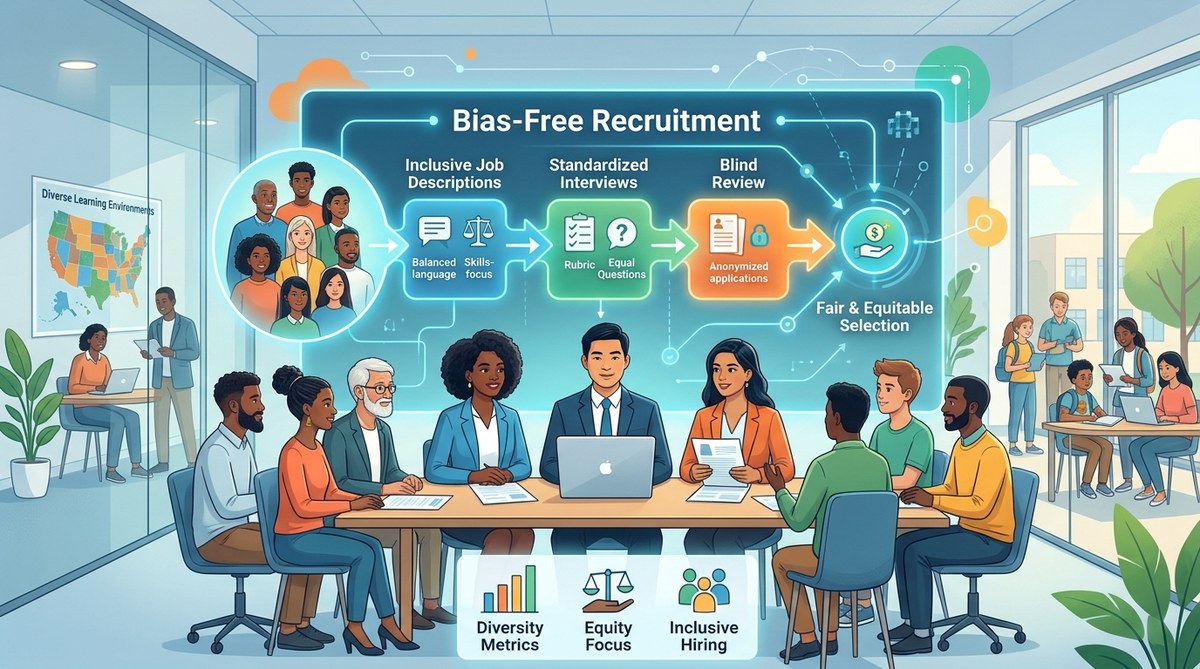
Bias in school hiring is not always intentional, but it is always harmful. This guide covers five practical steps to reduce bias: auditing your job descriptions, anonymizing resumes, standardizing interviews, using score rubrics, and training your hiring team. Each step helps you hire the best person for the job while building a more diverse and effective staff.
Why Bias Persists in School Hiring
Bias is not about bad people. It is about fast thinking. Your brain uses mental shortcuts to process information. When you see a resume, you make a snap judgment based on the name, the school, or the hometown. This is called unconscious bias.
In education, this matters a lot. Students benefit from seeing teachers and staff who reflect their own backgrounds. A diverse staff brings different perspectives, better problem-solving, and stronger connections with families. When your hiring process filters out diverse candidates before they even get an interview, your students lose out.
The first step is admitting that bias exists in your process. The next step is doing something about it.
Five Steps to a Bias-Free Hiring Process
Here is a numbered list of the most effective actions you can take right now.
-
Audit your job descriptions. Look for language that might discourage certain candidates from applying. Words like “strong leader” can subtly favor men. Phrases like “must have 10 years of experience” can exclude younger teachers or career changers. Use tools that scan for gendered or exclusionary language. Rewrite your descriptions to focus on the skills and qualities that truly matter for student success.
-
Anonymize resume screening. Remove names, addresses, and school names from resumes before your team reviews them. This simple step reduces bias related to race, gender, and socioeconomic background. Many applicant tracking systems can do this automatically. If you do not have that technology, ask a neutral staff member to redact the information by hand.
-
Standardize your interview process. Give every candidate the same set of questions. Do not let interviewers ask off-script questions that might favor certain backgrounds. Use a structured interview format where each question is tied to a specific skill or competency needed for the job. This ensures you are comparing apples to apples.
-
Use a scoring rubric. Create a simple scorecard for each interview question. For example, a candidate who demonstrates strong classroom management gets a 4, while one who cannot give a clear example gets a 1. This removes the “gut feeling” factor and forces your team to evaluate candidates on evidence.
-
Train your hiring team. Provide annual training on unconscious bias. Make sure everyone on the hiring committee understands how their own experiences shape their perceptions. This training should be practical, not just theoretical. Role-play scenarios where bias might appear and practice correcting it.
Common Mistakes and Better Alternatives
Sometimes the things you think are helping are actually making bias worse. Here is a table that compares common hiring mistakes with better practices.
| Mistake | Why It Is Harmful | Better Practice |
|---|---|---|
| Asking “Where did you go to school?” | Favors candidates from elite universities. | Ask about relevant teaching experience instead. |
| Relying on “cultural fit” | Often masks bias against people who are different. | Focus on “cultural contribution” instead. |
| Using unstructured interviews | Allows bias to influence questions and scoring. | Use a structured interview with a rubric. |
| Hiring based on a single strong reference | The reference might be biased or incomplete. | Check multiple references and ask specific questions. |
| Ignoring the commute or schedule | Can discriminate against candidates with caregiving duties. | Offer flexible scheduling and remote options. |
What to Do When You Find Bias
You will likely discover bias in your current process. That is okay. The goal is not to be perfect. The goal is to keep improving.
When you find a problem, name it. For example, if you notice that candidates from certain zip codes are consistently overlooked, ask why. Look at the data. Is your job posting reaching those communities? Are your screening criteria inadvertently excluding them?
Then, make a change. Maybe you need to post the job on different platforms. Maybe you need to adjust your required qualifications. Small tweaks can have a big impact.
“The most important thing is to be transparent about your efforts. Share your data with your staff and your community. Let them see that you are working on this. That builds trust and accountability.” — Dr. Maria Lopez, Director of Equity and Inclusion, Oakwood School District
How to Measure Your Progress
You cannot fix what you do not measure. Here are a few metrics to track over time.
- Applicant diversity. What percentage of your applicants come from underrepresented groups?
- Interview conversion rate. Are diverse candidates advancing to the interview stage at the same rate as others?
- Offer acceptance rate. Are you losing diverse candidates at the offer stage?
- Retention rate. Do diverse hires stay at your school as long as other staff?
Track these numbers each hiring cycle. If you see gaps, investigate and adjust.
Building a Culture of Fair Hiring
A bias-free hiring process is not a one-time project. It is a cultural shift. It requires ongoing attention and commitment.
- Involve diverse voices. Make sure your hiring committee includes people from different backgrounds, roles, and perspectives. This reduces groupthink and brings new ideas to the table.
- Ask for feedback. After each hiring cycle, ask candidates about their experience. What worked? What felt unfair? Use that feedback to improve.
- Celebrate wins. When you hire a great candidate who brings a new perspective, share that story. Show your community that fair hiring leads to better outcomes.
For more on how to create an environment where every student can thrive, read our guide on strategies to promote inclusive education for all students. You can also learn about how to use data to identify and address education gaps in underserved communities. And if you are wondering about the bigger picture, check out what are the biggest barriers to education equity in 2026.
Common Questions About Bias-Free Hiring
Q: Does bias-free hiring mean I cannot consider experience?
A: No. You should absolutely consider relevant experience. The key is to define what “relevant experience” means in clear, objective terms. Avoid vague requirements like “strong background in education.”
Q: What if I have a small applicant pool?
A: A small pool can still be diverse. Focus on where you are posting your jobs. Reach out to local community organizations, HBCUs, and minority-serving institutions. Build relationships before you need to hire.
Q: Is it legal to ask about a candidate’s race or gender?
A: You should not ask about these things in an interview. But you can track applicant demographics anonymously to measure your progress. Make sure candidates know this data is voluntary and confidential.
Your Bias-Free Hiring Checklist
Use this bulleted list to keep your process on track.
- [ ] Job descriptions are reviewed for biased language.
- [ ] Resumes are anonymized before screening.
- [ ] Interview questions are standardized and tied to job skills.
- [ ] A scoring rubric is used for every candidate.
- [ ] Hiring team receives annual bias training.
- [ ] Applicant diversity data is tracked each cycle.
- [ ] Candidates are asked for feedback after the process.
Moving Forward with Confidence
You do not need to overhaul your entire system overnight. Start with one step. Maybe it is rewriting your next job description. Maybe it is anonymizing resumes for your next hire. Whatever you choose, do it with intention.
Every time you make a fairer hiring decision, you send a message to your staff, your students, and your community. You are saying that equity matters. That every candidate deserves a fair shot. And that the best person for the job is not the one who looks like everyone else, but the one who brings something new.
This bias-free recruitment guide 2026 is just the beginning. Keep learning. Keep asking questions. And keep pushing for a hiring process that reflects the values you teach every day.