elias
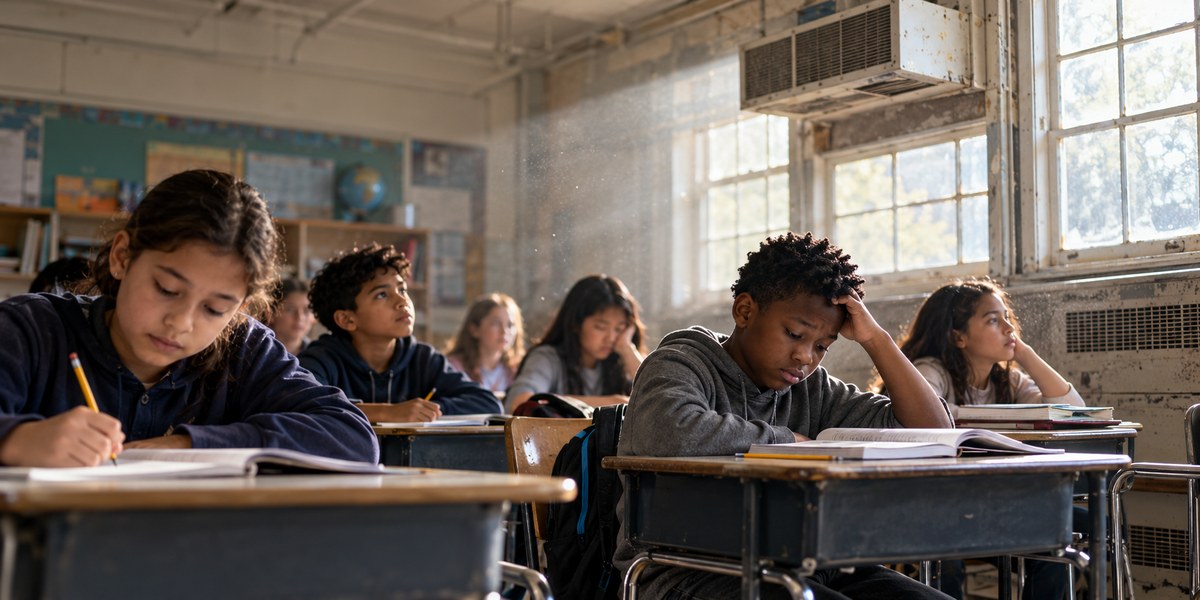
Every morning, millions of children walk into school buildings where the air they breathe might be harming their ability to learn. For students in low-income districts, this isn’t just a health issue. It’s an academic one. New research from 2026 shows a clear, hidden link between school air quality and the student achievement gap. When a school’s ventilation system fails, so do test scores. When mold grows in a classroom ceiling, attendance drops. And when districts cannot afford upgrades, the students who need the most support end up falling further behind.
Poor indoor air quality in schools directly harms student health, cognition, and attendance. These effects disproportionately impact low-income districts, widening the achievement gap. Fixing ventilation, filtering pollutants, and maintaining HVAC systems are proven strategies that boost academic outcomes. Policymakers and school leaders must treat air quality as a core education equity issue in 2026.
Why Air Quality Matters More Than You Think
The science is straightforward. Our brains need oxygen to function. When carbon dioxide builds up in a stuffy classroom, students get drowsy. Their focus slips. Decision-making slows down. A 2025 study from the Harvard T.H. Chan School of Public Health found that students in classrooms with high CO2 levels scored 12 to 15 percent lower on standardized tests compared to peers in well-ventilated rooms.
But CO2 is only part of the problem. Many older school buildings, especially those in underfunded districts, struggle with:
- Mold and mildew from leaking roofs and poor humidity control
- Volatile organic compounds (VOCs) from cleaning products, paints, and new furniture
- Particulate matter from nearby highways, industrial zones, or aging boilers
- Allergens like dust mites and pollen that trigger asthma attacks
These pollutants don’t just make kids cough. They cause headaches, fatigue, and respiratory illnesses that keep students home. And when students miss school, they miss instruction. That lost time compounds year after year.
For a deeper look at how physical spaces affect learning, read our guide on the impact of school design on student well-being and academic success.
The Hidden Link to the Achievement Gap
Here is where the equity piece comes in. Not all schools breathe the same air. A 2026 report from the Government Accountability Office found that more than half of public school districts in the United States need to update or replace multiple building systems, including HVAC. But the burden is not shared equally.
Schools in low-income districts are far more likely to have:
| Issue | High-income districts | Low-income districts |
|---|---|---|
| Working HVAC in all classrooms | 89% | 47% |
| Recent mold remediation | 72% | 34% |
| Air quality monitoring systems | 65% | 22% |
| Portable air purifiers in classrooms | 58% | 18% |
This table shows a clear pattern. The schools that serve the most vulnerable students are the ones with the worst air. And because children from low-income families already face higher rates of asthma and other respiratory conditions, the impact is doubled.
Dr. Maria Lopez, a public health researcher at the University of California, put it this way:
“We are asking children to climb a mountain in flip-flops while their peers in wealthier districts wear hiking boots. Poor air quality is a systemic barrier that we can measure, and it is directly tied to the achievement gap we keep trying to close with curriculum reforms alone.”
Her research team followed 10,000 students across five states over three years. They controlled for teacher quality, class size, and family income. The result? Students in schools with poor air quality showed significantly slower growth in reading and math, regardless of other factors.
How Poor Air Hurts Learning Every Day
The effects are not just long-term. They happen in real time. Here is what a bad air day looks like for a student in an underfunded school:
- The student arrives at a school built in 1972. The HVAC system was last updated in 1998. It runs loud and cycles unevenly.
- By 10 a.m., CO2 levels in the classroom hit 1,800 parts per million. The recommended maximum is 1,000 ppm. Students start rubbing their eyes and putting their heads down.
- During third period, a student with asthma has an attack triggered by dust from an old carpet. She goes to the nurse’s office and misses a full lesson on fractions.
- By lunch, the room temperature has climbed to 78 degrees. Humidity is high. Students are restless and distracted.
- After school, the same student goes home to a house where she also breathes poor air. Her lungs never get a break.
This cycle repeats day after day. The cognitive load of simply being uncomfortable and unwell eats into the mental energy available for learning.
If your district is ready to take action, our guide on implementing effective school health programs to boost student well-being offers practical steps.
What Policymakers and Administrators Can Do
Fixing school air quality is not cheap, but it is cost-effective when you consider the return on investment. Every dollar spent on ventilation improvements can yield four dollars in reduced illness and improved academic performance. Here is a step-by-step process for districts that want to close the achievement gap by cleaning up the air.
A practical 5-step action plan
-
Conduct a full building audit. Hire an industrial hygienist or use low-cost sensors to measure CO2, humidity, particulate matter, and VOCs in every classroom. Do this during a typical school day, not on a weekend.
-
Prioritize the worst buildings first. Use the audit data to rank schools by need. The buildings with the highest CO2 levels and most complaints should go to the top of the list.
-
Fix the basics before buying gadgets. Seal leaks, clean ducts, replace old filters, and ensure HVAC systems are balanced. A $500 filter change can do more than a $5,000 air purifier if the system is working properly.
-
Invest in continuous monitoring. Install real-time CO2 sensors in classrooms. When levels rise, teachers can open windows or adjust ventilation. Some states now offer grants for this equipment.
-
Build maintenance into the budget. The biggest mistake districts make is buying new equipment without funding its upkeep. Filters need to be changed every three months. Coils need cleaning. Plan for it.
For more ideas on how to create supportive conditions for all students, check out our strategies on building school policies that support child wellbeing and equity.
Common Mistakes Districts Make
Even well-intentioned efforts can go wrong. Here are three pitfalls to avoid.
-
Buying cheap air purifiers in bulk. Many portable purifiers are too small for classroom square footage. They also create noise that distracts students. Always match the purifier’s Clean Air Delivery Rate (CADR) to the room size.
-
Sealing windows tight without checking ventilation. Some schools try to save energy by sealing everything shut. This traps CO2 and pollutants inside. Energy efficiency and air quality must be balanced, not traded.
-
Ignoring the source of the problem. If mold is growing in the walls, an air purifier is a band-aid. You have to remove the mold and fix the leak. Treat causes, not symptoms.
The Federal and State Landscape in 2026
There is good news. In 2026, more funding streams are available than ever before. The EPA’s Indoor Air Quality Tools for Schools program offers free technical assistance. The bipartisan infrastructure law passed in 2024 set aside $500 million specifically for school ventilation upgrades. Many states, including California, New York, and Illinois, have added their own matching funds.
But accessing this money requires advocacy. School board members, parent-teacher groups, and community organizations need to push for applications to be submitted. The funds are competitive. Districts that wait may miss the window.
Parents and advocates can learn how to make their voices heard in our article on how community partnerships can strengthen education equity efforts.
Why This Is an Equity Issue We Can Solve
Unlike poverty or family structure, school air quality is something we can change with policy and funding. It is a concrete lever. When a district installs better ventilation, the air gets cleaner that same week. Students feel better. Attendance goes up. Test scores follow.
This is not a mystery. It is engineering and public health working together. The challenge is political will and resource allocation. Low-income districts have been underfunded for decades. Their buildings are older. Their tax bases are smaller. They cannot fix this problem alone.
State and federal governments must step in with targeted funding. School districts must prioritize health over aesthetics. And parents must keep asking the question: What is my child breathing right now?
If you are a policymaker or administrator looking for a framework to guide your work, our piece on implementing effective education policies to promote equity and inclusion provides a helpful starting point.
A Call to Action for 2026
The link between school air quality and the student achievement gap is no longer hidden. We have the data. We have the solutions. What we need now is action.
Start small if you have to. Measure the air in one classroom. Change the filters in one school. Advocate for one line item in the budget. Every step forward is a step toward closing the gap.
The students in low-income districts are not less capable than their peers. They are simply breathing air that makes it harder to succeed. Let’s give them the same clean air that students in wealthier schools already have. They deserve it. And they are counting on us to make it happen.