elias
elias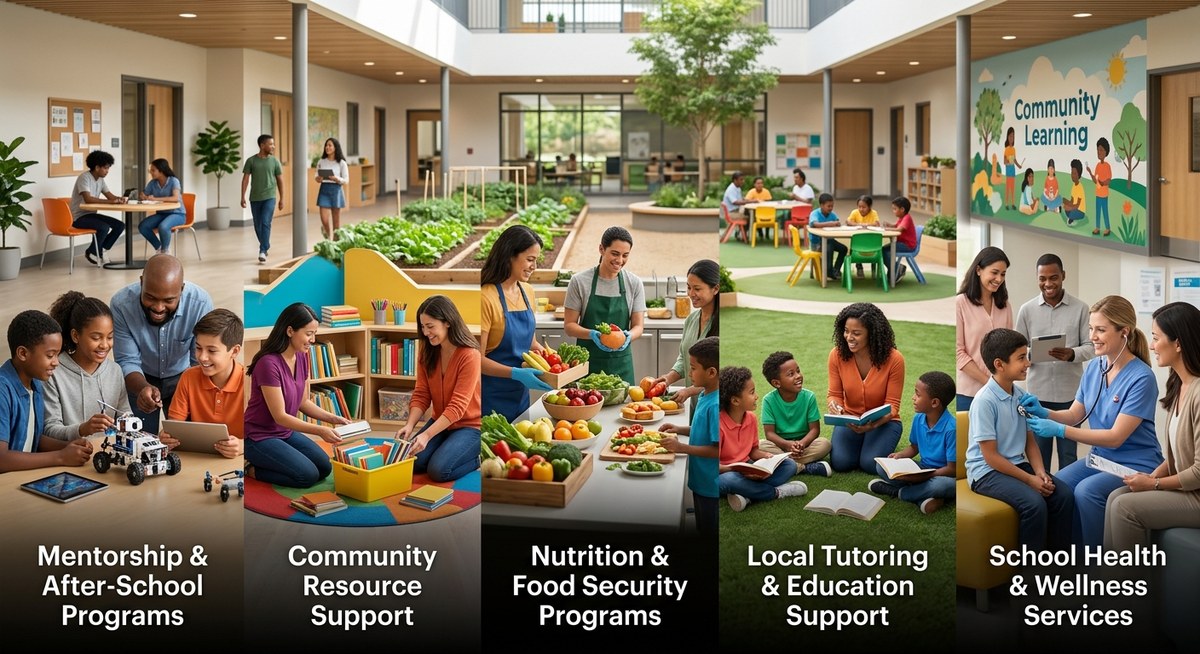
Across the United States, the most powerful solutions to education inequity aren't coming from Washington or state capitols. They are emerging from neighborhoods, church basements, library meeting rooms, and community centers. Parents, teachers, local leaders, and students themselves are building programs that address the specific barriers their communities face. These efforts prove that lasting change happens when the people closest to the problems are trusted to design the answers.
Community-led education equity initiatives succeed because they are built on local trust, cultural knowledge, and real relationships. When schools partner with families and grassroots organizations to design solutions like free tutoring, parent leadership pipelines, and culturally responsive after-school programs, students see measurable gains in attendance, confidence, and academic performance. The five models shared here are replicable and scalable.
Why Community Leadership Is Essential for Equity
Top-down education reforms often miss the mark because they ignore the lived reality of students and families. A policy written in a state boardroom cannot anticipate the specific challenges of a rural school district in Mississippi or an urban neighborhood in the Bronx. Community-led education equity initiatives fill that gap. They start by listening.
When a program is designed by the people it serves, trust is baked in from day one. Families are more likely to show up, participate, and stay engaged when they see their own voices reflected in the solution. This approach also surfaces barriers that outsiders might miss like transportation gaps, language access issues, or cultural mismatches in curriculum.
Let's look at five specific initiatives that are closing the equity gap in 2026.
1. The Parent-Teacher Home Visit Project
This initiative began in Sacramento, California, and has now spread to dozens of school districts across the country. The concept is simple: teachers visit students' homes, not for a disciplinary meeting, but to build a genuine relationship with the family.
How It Works
Teachers receive training on how to conduct visits with humility and cultural awareness. They go to the home empty handed no clipboards, no paperwork, no list of complaints. Instead, they ask parents two questions: "What are your hopes for your child?" and "How can we work together to make those hopes real?"
Measurable Results
Schools that participate in this model see higher attendance rates, fewer disciplinary referrals, and stronger academic performance. More importantly, parents report feeling like true partners in their child's education.
"When a teacher walks into your living room and asks about your dreams for your child, it changes the entire relationship. You stop seeing each other as adversaries and start working as a team." Maria Gonzalez, parent leader in Fresno Unified School District
This approach is one of the most effective strategies to promote inclusive education for all students because it builds the relational trust that every other reform depends on.
2. The Freedom Schools Literacy Model
Originally developed by the Children's Defense Fund, Freedom Schools have been adapted and run by community organizations in more than 100 cities. These summer and after-school programs combine literacy instruction with social justice, cultural pride, and civic engagement.
Core Components
- Culturally relevant books written by and about people of color
- Small group instruction with a low student-to-teacher ratio
- A curriculum that connects reading to real world issues
- Daily "integrated reading" sessions where students discuss themes like fairness, courage, and community
- Parent involvement workshops that build advocacy skills
Students in Freedom Schools typically gain two to three months of reading growth over a single summer. That is a meaningful step toward closing the achievement gap, especially for students who lose ground during the break.
This model aligns closely with innovative approaches to closing education gaps for marginalized students, as it centers student identity and community wisdom.
3. Community-Based Tutoring Corps
Private tutoring is expensive. Many families in underserved communities cannot afford $50 to $80 per hour for one-on-one academic support. Community-based tutoring corps solve this problem by training local volunteers, college students, and even retired teachers to provide free or low-cost tutoring in neighborhood spaces.
A Successful Example: The Oakland Learning Corps
In Oakland, California, a coalition of community organizations created a tutoring corps that places trained tutors in public housing community rooms, recreation centers, and faith-based organizations. Tutors are often residents of the same neighborhood, which builds trust and consistency.
| Common Tutoring Approach | Mistake to Avoid |
|---|---|
| Using a rigid, one-size-fits-all curriculum | Ignoring the student's individual learning gaps and cultural context |
| Focusing only on test prep | Neglecting student confidence, motivation, and love of learning |
| Hiring tutors from outside the community | Missing the relational trust that local tutors bring |
| Offering sessions only during school hours | Excluding students who need support in the evenings or weekends |
| Measuring success only by test scores | Overlooking improvements in attendance, engagement, and self-esteem |
The Oakland Learning Corps tracks both academic growth and social-emotional indicators. Students who attend regularly show gains in math and reading, but they also report feeling more connected to their community.
For schools looking to replicate this model, how community partnerships can strengthen education equity efforts offers a practical roadmap for building these relationships.
4. Parent Leadership and Advocacy Pipelines
Too often, parent engagement is limited to bake sales and parent-teacher conferences. Community-led initiatives are changing that by training parents to become advocates, organizers, and even board members.
A 3-Step Process for Building a Parent Leadership Pipeline
-
Recruit and build trust. Identify parent leaders through existing networks like PTAs, faith communities, and neighborhood associations. Hold listening sessions in accessible locations with childcare and translation services provided.
-
Train on systems and power. Teach parents how school budgets work, how school board decisions are made, and how to advocate at the district and state level. Use real examples from their own children's schools.
-
Create meaningful roles. Place trained parents on district committees, school site councils, and equity task forces. Pay them a stipend for their time. Their expertise is valuable and should be compensated.
One powerful example comes from the Southwest Organizing Project in Chicago, where parents successfully pushed for more bilingual staff, improved playground safety, and a new community school model in their neighborhood.
This work is essential for building school policies that support child wellbeing and equity, because parents bring perspectives that no administrator can fully represent.
5. Culturally Responsive After-School and Summer Programs
The hours between 3 PM and 6 PM, along with summer break, represent both a risk and an opportunity. For students in under-resourced communities, these hours can be a time of learning loss or disengagement. But well-designed community programs turn that time into a powerful lever for equity.
What Makes a Program Culturally Responsive?
- Curriculum reflects the histories, languages, and traditions of the students
- Staff look like the students and share their cultural background
- Families are invited to share stories, recipes, and traditions as part of the learning
- Academic support is woven into activities that feel relevant and engaging, not like more school
A program in Albuquerque, New Mexico, called "STEM en la Comunidad" pairs Indigenous and Latino middle school students with local scientists and engineers who share their cultural background. Students build robots, test water quality in nearby rivers, and design solar ovens. Attendance is nearly 95 percent, and participants show improved math scores and higher interest in STEM careers.
For more on creating these kinds of spaces, check out how to foster child-centered learning environments that enhance equity.
How to Start or Support a Community-Led Initiative in Your Area
If you are an educator, policymaker, or advocate who wants to support community-led education equity initiatives, here are some practical steps you can take right now.
What to Do First
- Listen before you act. Spend time in the community attending events, visiting homes, and hearing what families actually say they need.
- Identify existing assets. Every community has leaders, organizations, and institutions that are already doing good work. Build on what is already there.
- Provide flexible funding. Grant money with too many restrictions can kill grassroots innovation. Trust local leaders to spend money wisely.
- Measure what matters. Attendance, suspensions, and test scores are important, but so are parent trust, student belonging, and community pride.
What to Avoid
- Do not parachute in with a pre-built solution. That is the opposite of community-led.
- Do not expect immediate results. Building trust takes time, often years.
- Do not ask community members to volunteer endlessly. Pay them for their expertise and time.
For a deeper look at the structural barriers these initiatives are up against, read about what are the biggest barriers to education equity in 2026.
Sustaining Momentum When Funding Gets Tight
Every community-led initiative faces the challenge of sustainability. Grants run out. Political priorities shift. Leaders burn out. But the most resilient programs build sustainability into their DNA from the start.
Strategies That Work
- Develop a mix of funding sources: local foundations, school district contracts, individual donations, and earned revenue like paid training workshops for other organizations.
- Document everything. Create a simple handbook that explains your model so it can survive staff turnover.
- Invest in young people. Train high school and college students to become tutors, mentors, and organizers. They will carry the work forward.
- Build political power. When families know how to show up at school board meetings and advocate for their program, it becomes much harder to cut.
The most inspiring thing about these initiatives is not their funding model, it is their stubborn commitment to students. When a program is truly community-led, the community will fight to keep it alive.
A Final Word on What This Means for You
You do not need to wait for a federal policy change or a new state mandate to start closing the education equity gap. The tools are already in your community. The parents, teachers, and students around you are full of ideas and energy. Your job is to listen, to show up consistently, and to clear the obstacles that stand in their way.
Community-led education equity initiatives remind us that the people closest to the problem are also closest to the solution. Trust them. Fund them. Get out of their way when they need space, and step in to help when they ask for it. That is how we close the gap not with a single grand plan, but with thousands of small, determined, locally rooted efforts that add up to something unstoppable.
If you want to go deeper into any of these strategies, empowering educators to advance educational equity in diverse classrooms is a great next step. The work is hard, but you are not alone in it.