elias
elias
Every student deserves a fair shot at a great education, but that shot starts with how we fund our schools. For decades, education reform has focused on curriculum, teacher training, and standards. Those pieces matter, but they cannot succeed without a healthy foundation. That foundation is school funding equity. When districts with high poverty receive far less money per student than wealthy suburbs, no amount of new lesson plans will close the opportunity gap. In 2026, the conversation is finally shifting from “what works in the classroom” to “who gets the resources to make it work.” This article breaks down why funding is the missing piece in education equity reform and what you can do about it.
Equitable school funding is not a side issue in education reform. It is the foundation that makes all other reforms possible. When funding formulas favor wealthy districts, even the best curriculum and teaching cannot overcome resource gaps. Advocates must push for weighted funding, community oversight, and state level accountability to ensure every student gets the support they need to succeed.
How Funding Gaps Undermine Every Reform Effort
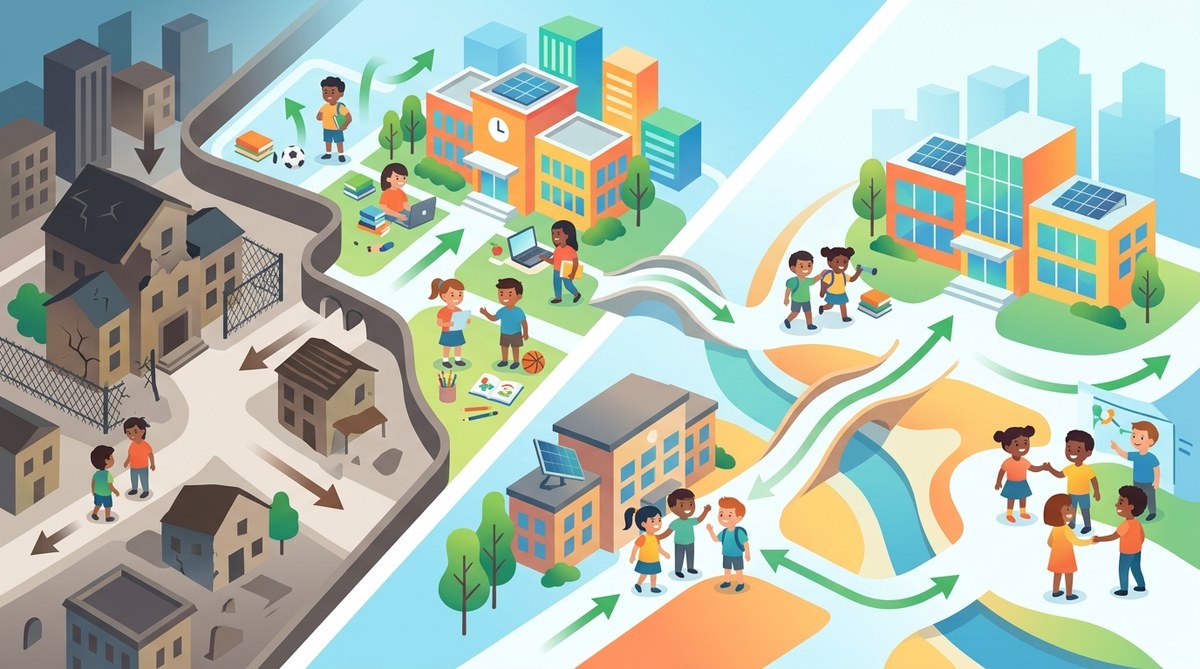
Talk to any teacher in a low income district. They will tell you about outdated textbooks, crumbling buildings, and classes with 35 students. Now talk to a teacher in a wealthy suburb. Smaller classes, up to date technology, full arts programs, and counselors available for every grade. Those differences are not accidents. They are the direct result of state and local funding policies that treat a child’s zip code as a measure of worth.
Research shows that spending differences matter. A landmark study from the National Bureau of Economic Research found that a 10 percent increase in per pupil spending for low income students leads to higher graduation rates and lifetime earnings. When money is allocated fairly, outcomes improve. When it is not, reform initiatives like new reading programs or technology integration simply cannot take root.
School funding equity is not just about dollars. It is about dignity. It is about giving every child a fair chance to learn in an environment that supports their growth. Without that foundation, the most well intended reforms will always hit a ceiling.
The Real Reasons Funding Formulas Stay Unfair
Many people assume school funding is a solved problem. After all, the federal government provides Title I money for low income schools, and states have equalization formulas. But the reality is messier. Most school funding still comes from local property taxes. That means a house in a poor neighborhood generates less revenue per student than a mansion next door. State formulas try to offset this, but they often fall short.
Here are the three common barriers that keep funding inequity alive:
- Property tax reliance: Districts with low property values cannot raise enough money, even with higher tax rates.
- Political inertia: Wealthy districts fight to keep their advantage, making it hard to pass fair funding formulas.
- Inadequate weighting: Even progressive formulas fail to account for the additional costs of poverty, special education, and English language learning.
These barriers are not impossible to overcome. But they require sustained advocacy from everyone involved in education.
Four Practical Steps to Advocate for School Funding Equity
If you are a school administrator, policy researcher, or advocate, you can take concrete action. Use this process to move from frustration to progress.
-
Audit your current funding formula. Pull your state’s per pupil spending data for each district. Compare the numbers between high poverty and low poverty areas. Identify where the gap is largest.
-
Build a coalition with parents and community groups. Funding reform is political. You need voices from across your district, not just educators. Parents who see their children crowded into trailers are powerful allies.
-
Advocate for weighted student funding. This approach allocates more money for students who need more support, such as those in poverty, English learners, and students with disabilities. It is transparent and targetable.
-
Use data to tell the story. Collect graduation rates, test scores, and chronic absenteeism numbers. Show how funding gaps correlate with student outcomes. Data backed stories are harder for policymakers to ignore.
For deeper strategies on closing gaps, consider reading about innovative approaches to closing education gaps for marginalized students.
Common Mistakes and Best Practices in Funding Allocation
Decades of funding experiments have taught us what works and what does not. The table below highlights the most common mistakes districts make and the practices that lead to real equity.
| Common Mistake | Best Practice |
|---|---|
| Using across the board cuts during budget shortfalls | Protecting funds for high need students first |
| Funding formulas that ignore differences in student need | Weighted student funding based on poverty, ELL, and special ed |
| Allocating technology money to all schools equally | Prioritizing schools with the least access to devices and internet |
| Relying only on local property tax revenue | Combining local, state, and federal dollars with progressivity |
| Not tracking how money is spent at the school level | Requiring transparent school level budgets and audits |
| Cutting support staff like counselors and nurses | Keeping pupil support ratios equal across high and low income schools |
These practices may seem obvious, but many districts still fall into the old traps. The shift toward school funding equity requires constant vigilance.
What Policymakers Need to Hear
“Adequate and equitable school funding is not a favor to poor districts. It is a public good that benefits the entire state economy. When we invest in all children, we lower crime rates, reduce health costs, and build a stronger workforce. The price of inequity is higher than the price of fairness.”
— Dr. Maria Sanchez, education finance researcher
Advocates should use this message when speaking to state legislators. Avoid framing funding equity as charity. Frame it as smart economics. Every dollar spent on a child in a high poverty school yields a long term return. Policymakers need to understand that cutting funding from low income districts does not save money; it shifts costs to social services and prisons later.
A Blueprint for Action in 2026
The year 2026 brings new opportunities. Several states are revisiting their school funding formulas after pandemic era federal aid expired. That creates a opening for reform. Here is a three part plan.
- Short term: Push for emergency supplements to districts with the highest poverty rates. Many states still have unspent COVID relief funds that can be redirected.
- Medium term: Launch a public awareness campaign about the real dollar gaps in your state. Use easy to understand graphics.
- Long term: Advocate for a constitutional amendment or state law that guarantees adequate and equitable funding for every student.
You can also explore effective education policies to promote equity and inclusion for more policy blueprints.
The Role of School Design and Environment
Equitable funding does not stop at teacher salaries. It also pays for the physical spaces where children learn. Schools in underfunded districts often have poor lighting, outdated HVAC systems, and no dedicated spaces for art or music. These conditions affect student health and focus. When you fight for funding equity, you are also fighting for better learning environments.
Learn more about the impact of school design on student well being and academic success to understand how physical spaces tie into the bigger picture.
A Stronger Future Starts With Fair Funding
School funding equity is not just a side issue in education reform. It is the engine that makes everything else run. Without it, even the most innovative teaching methods will struggle to reach students who lack basic resources. With it, every child has a real chance to thrive.
If you are tired of seeing the same reforms fail year after year, start looking at the budget. Follow the money. Ask who gets what and why. Push for a system where every school, regardless of its neighborhood, has the tools to educate. That is the work that will finally make equity a reality, not just a goal.