elias
elias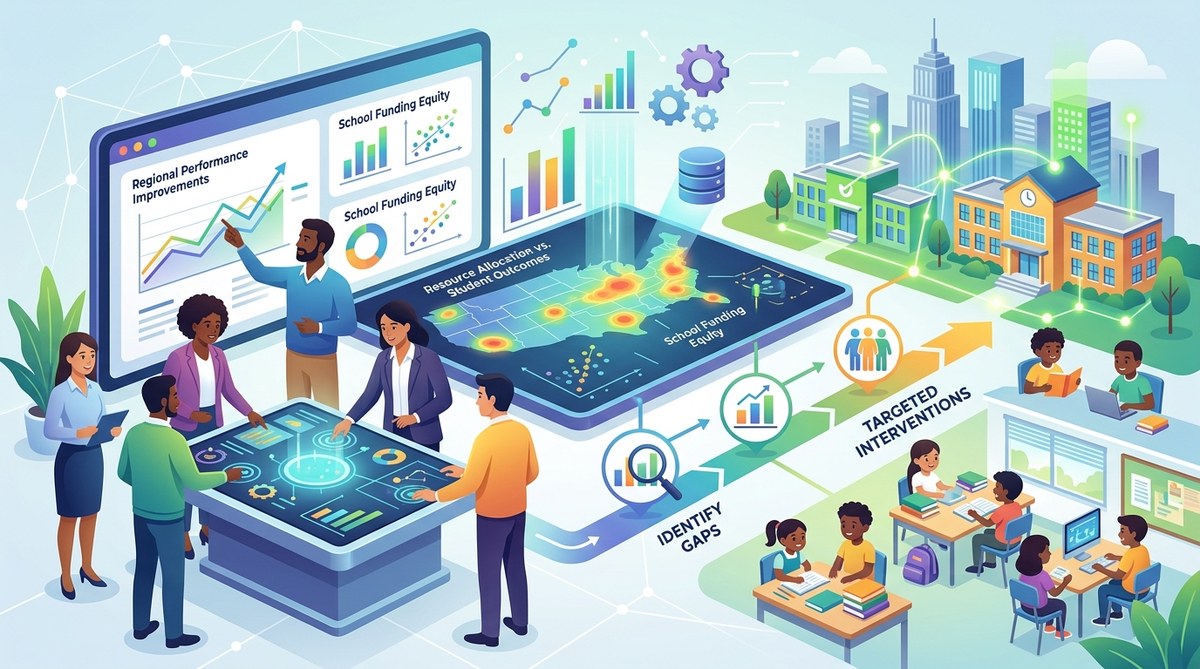
A middle school in rural Mississippi noticed something that surprised its teachers. Students who scored low on reading comprehension in the fall were often the same kids who missed three or more days a month. The school had the data on attendance and the data on reading levels, but no one had put the two together. When they finally connected those spreadsheets, they uncovered a pattern that led to a simple fix: a morning check-in program for chronic absentees. Within one semester, reading scores started climbing.
This story shows what happens when schools shift from collecting data to actually using it. You do not need a giant district budget or a team of data scientists to make this work. You need a clear process, the right questions, and the courage to let numbers guide your decisions. In 2026, the gap between high-income and low-income students in the U.S. remains stubbornly wide. Standardized test scores, graduation rates, and access to advanced coursework all show persistent disparities. But the schools that are closing those gaps share one thing in common: they have built a culture where data drives action, not just reporting.
Using data to address education gaps in underserved communities means moving from broad averages to specific, actionable insights. The goal is to spot patterns that point to root causes, not just symptoms. With a few practical steps, any school or district can start turning numbers into tailored interventions that lift students who need the most support.
Start with the Right Questions, Not the Right Tools
Many schools make the mistake of buying a fancy dashboard before they know what they want to ask. A dashboard looks impressive, but it will not tell you why a particular classroom is falling behind or which students need a reading intervention versus an attendance intervention. Before you open a single spreadsheet, sit down with your team and list the gaps you suspect exist.
For example, you might wonder: Are our English learners in third grade progressing at the same rate as their peers? Which middle school math classrooms show the widest spread between top and bottom performers? How does moving from one school to another mid-year affect test scores in our low-income neighborhoods?
Write down three to five questions like these. They become your compass. Every piece of data you pull should help answer at least one of them. This focused approach prevents the overwhelm that comes from looking at every metric at once.
Types of Data That Reveal Hidden Gaps
You probably already have more data than you realize. The trick is to know which kinds of data highlight inequity most clearly. Here are the categories to pay attention to:
- Academic performance data: test scores, grades, course completion rates, and grade-level proficiency. Break these out by race, income level, English learner status, and special education status.
- Operational data: attendance, suspensions, office referrals, mobility rates (how often students change schools), and chronic absenteeism. These often predict academic trouble long before test scores drop.
- Program access data: who is in gifted programs, AP classes, or after-school tutoring. Underserved students are often underrepresented in advanced courses.
- Qualitative data: teacher observations, student surveys, and family feedback. Numbers tell you what is happening; stories tell you why.
A 2026 analysis from the National Center for Education Statistics showed that schools using at least three of these data types together were twice as likely to reduce achievement gaps over two years compared to schools that relied on test scores alone.
A Practical Process to Go from Data to Action
You can build a repeatable cycle with four steps. This keeps your data work sustainable, not a once-a-year panic before state testing.
Step 1: Gather and disaggregate. Pull your data and break it down by student groups. Do not just look at the school average. Look at how Black students compare to white students, how free-lunch students compare to paid-lunch students, and how students with disabilities compare to peers without IEPs. If you see a gap of more than 10 percent in any of these comparisons, flag it.
Step 2: Identify the root cause. A gap in reading scores might actually be caused by high absence rates. Or it might be caused by a lack of access to grade-level texts at home. Use your qualitative data to test your hypotheses. Talk to teachers. Survey families. A pattern might emerge that a spreadsheet alone would miss.
Step 3: Design a targeted intervention. One-size-fits-all programs rarely work for underserved communities. Instead, create a small, focused response. For instance, if you find that girls in your low-income elementary school are falling behind in math confidence by fourth grade, you might start a weekly girls-only math club with a female teacher leader.
Step 4: Monitor and adjust. Do not wait until the end of the year to see if the intervention worked. Set benchmarks at six and twelve weeks. If the data shows little change, tweak the approach. This is where a simple spreadsheet or a free tool like Google Sheets can track progress per student.
Common Mistakes Schools Make with Data (and How to Avoid Them)
Even well-intentioned teams fall into traps. The table below outlines the most frequent errors and what to do instead.
| Mistake | Why It Hurts | Better Approach |
|---|---|---|
| Looking only at averages | Averages hide the struggles of smaller groups, especially in small schools. | Always disaggregate by race, income, language, and special needs. |
| Using data to blame teachers | When data feels punitive, teachers hide problems instead of sharing them. | Frame data as a tool for support, not evaluation. |
| Collecting too many metrics | Teams get buried and never act. | Stick to a few key indicators that tie to your core questions. |
| Waiting for perfect data | By the time data is perfect, students have moved on. | Use what you have now, note its limitations, and adjust later. |
| Ignoring student voice | Numbers do not capture trauma, hunger, or family stress. | Pair every data point with a conversation or survey. |
An Expert Perspective on Data as an Equity Lever
“Data is not the enemy of equity; it is a flashlight. When we shine it on the places where opportunities are not equal, we have a moral obligation to change what we see. The question is not whether we have enough data. It is whether we have the will to act on it.”
Dr. Mia Torres, Assistant Superintendent for Equity and Innovation, Fresno Unified School District
This quote captures the heart of the work. Data reveals disparities that are already there. It does not create them. But once you see the gap, you owe it to your students to close it.
Schools that use data effectively often pair it with broader efforts to address systemic barriers. For instance, when a school notices that students from one neighborhood consistently miss more days, they might partner with local community organizations to provide transportation or health services. That is the kind of holistic thinking that makes data truly powerful.
If you are ready to build a more inclusive school environment, you might find value in strategies to promote inclusive education for all students. And if you want to tackle the bigger picture, consider reading about how schools can effectively address systemic barriers to education equity in 2026.
A Simple Data Review Cycle You Can Start Next Week
Do not let this feel overwhelming. You can begin with one meeting and one question. Here is a suggested rhythm:
- Weekly (15 minutes per grade team): Check attendance and behavior referrals for any students who fell off track. Flag three students to check in on.
- Monthly (1 hour per school leadership team): Review a single academic indicator (e.g., reading benchmark scores). Compare by subgroup. Find one gap to address.
- Quarterly (2 hours with all staff): Share a data story. Show a before-and-after of an intervention. Celebrate wins. Adjust strategies that are not working.
- Annually (half-day retreat): Look at year-over-year trends. Ask: Did we shrink gaps? Where did we get stuck? What new questions do we have for the coming year?
This cycle keeps the focus on progress, not perfection. And it builds a habit of data use that becomes second nature.
Turning Numbers into Real Student Progress
Data does not change lives. Teachers, principals, and support staff do. But data gives them direction. It turns a hunch about what might be wrong into a clear path forward.
Think of the school in Mississippi that connected attendance and reading. They did not need a million-dollar platform. They needed a willingness to look at two columns of numbers side by side and ask, “What is this telling us?” When you adopt that mindset, you can begin to dismantle the education gaps that have persisted for generations.
Start small. Pick one question from the list you wrote earlier. Gather the data. Talk to the people who work with those students every day. Try one change. Watch what happens. Then adjust and repeat. That is how you use data to address education gaps in underserved communities, one honest look at the numbers at a time.
For more guidance on building the kind of school environment where every child can thrive, check out our piece on transforming learning environments to promote equity and inclusion. And if you are curious about the top barriers holding students back right now, we have a deep look at what are the biggest barriers to education equity in 2026.