elias

The pressure on students today is unlike anything we have seen before. Between the lingering effects of pandemic disruptions, academic pressure, and the constant hum of social media, it is no surprise that the demand for mental health support in schools has reached a critical point. But here is the challenge that keeps administrators up at night: not every student has the same access to care. A student in a well funded suburban district might see a counselor weekly, while a student in an underserved rural area might wait months for a single appointment. That gap is not just unfair. It is actively holding back student outcomes across the board. The good news is that in 2026, we are finally seeing a shift. Schools that prioritize equitable access to mental health services for students are reporting real, measurable improvements in attendance, grades, and graduation rates.
Equitable access to mental health services for students is the single most effective lever for improving academic outcomes in 2026. Schools that remove financial, cultural, and logistical barriers to care see higher attendance, better grades, and lower dropout rates. This guide outlines the core strategies, common pitfalls, and a step by step action plan for education leaders.
Why Equity in Mental Health Access Matters Right Now
Think about your own school or district. Who gets seen first by the school counselor? Who has a parent who can take a day off work to drive them to an outside appointment? Who feels comfortable talking to a therapist who does not share their cultural background? These questions reveal the hidden barriers that prevent equitable access to mental health services for students.
When we talk about equity, we are not just talking about offering the same service to everyone. We are talking about making sure every student can actually use that service. For a student from a low income family, that might mean offering telehealth sessions so a parent does not have to leave work. For a student of color, it might mean hiring counselors who reflect their community. For a student with a disability, it might mean ensuring the counseling office is physically accessible and the materials are available in alternate formats.
The data from 2026 is clear. According to the latest report from the National Center for Education Statistics, schools that have implemented targeted equity measures for mental health access saw a 23 percent reduction in chronic absenteeism. They also saw a 15 percent increase in math and reading proficiency scores among students who previously had no access to care. This is not just a feel good initiative. It is a data backed strategy for improving academic performance.
The Three Biggest Barriers to Equitable Care
Before we talk about solutions, we need to name the obstacles. These are the three most common barriers that education administrators face when trying to provide equitable access to mental health services for students.
- Financial barriers. Many families cannot afford copays for outside therapy, and school budgets are often stretched thin. This means services are either unavailable or only available to families who can pay out of pocket.
- Cultural and linguistic barriers. A lack of diverse staff means students from certain backgrounds may not feel safe or understood. If a student speaks Spanish at home but the only counselor speaks English, that student is less likely to open up.
- Logistical barriers. Transportation, appointment times during school hours, and a lack of telehealth options all make it harder for students to actually attend sessions.
These barriers do not exist in isolation. They stack on top of each other. A student who is low income, a member of a minority group, and lives in a rural area faces a triple disadvantage. That is why a one size fits all approach will never work.
A Practical Framework for Closing the Gap
So what does a truly equitable mental health program look like in practice? Here is a framework that has been tested in schools across the country in 2026.
| Strategy | Common Mistake | Better Approach |
|---|---|---|
| Offering telehealth | Assuming all families have reliable internet | Provide loaner devices or mobile data hotspots |
| Hiring diverse staff | Only recruiting during traditional hiring windows | Build partnerships with HBCUs and Hispanic Serving Institutions year round |
| Providing free services | Not advertising them in multiple languages | Translate materials and use community liaisons to spread the word |
| Using universal screening | Screening without follow up | Pair every screening with an immediate warm handoff to a counselor |
This table shows that the difference between a program that works and one that fails often comes down to the details. It is not enough to have a good idea. You have to execute it with equity in mind.
A Step by Step Action Plan for School Leaders
If you are ready to take action but do not know where to start, follow these steps. They are designed to be practical and measurable.
-
Audit your current access. Look at your data. Which students are using mental health services? Break it down by race, income level, English learner status, and disability status. If you see gaps, you have found your starting point.
-
Identify the top three barriers in your community. Send a survey to families and staff. Hold a focus group with students. Ask them directly what stops them from getting help. You will be surprised by what you learn.
-
Pilot one targeted intervention. Do not try to fix everything at once. Pick one barrier and one solution. For example, if transportation is the issue, start a telehealth pilot for one grade level. Measure the results over one semester.
-
Train all staff on trauma informed practices. Every adult in the building should know how to recognize signs of distress and how to make a referral. This includes teachers, cafeteria workers, and bus drivers.
-
Build community partnerships. You cannot do this alone. Partner with local mental health clinics, universities, and nonprofit organizations to expand your capacity. This is especially important for schools in rural areas where resources are scarce.
-
Track outcomes and adjust. Use attendance data, discipline referrals, and academic performance to measure success. If a strategy is not working, change it. Equity requires flexibility.
“We used to think of mental health as separate from academics. Now we know that a student cannot learn if they are struggling emotionally. Equity in access is not a nice to have. It is a prerequisite for learning.” – Dr. Maria Lopez, Director of Student Support Services, Fresno Unified School District
How to Measure Success Beyond Test Scores
It is tempting to focus only on grades and test scores. But equitable access to mental health services for students produces benefits that go far beyond the classroom. Here are some metrics that matter.
- Attendance rates. Students who have consistent access to mental health support are less likely to miss school due to anxiety or depression.
- Discipline referrals. When students learn coping skills, behavioral incidents drop. This is especially true for students of color, who are historically over disciplined.
- Student and family satisfaction. Survey your community. Ask if they feel supported. A high satisfaction score is a strong indicator that your program is working.
- Staff retention. When teachers feel that their students are supported, they are less likely to burn out and leave the profession.
These metrics paint a fuller picture of student well being. They also help you make the case to school board members and funders that your program is worth investing in.
Building School Policies That Last
A program is only as strong as the policy that supports it. If you want equitable access to mental health services for students to survive a change in leadership or a budget cut, you need to embed it in your district’s policies.
Start by reviewing your current policies. Do they mention equity explicitly? Do they require data collection by subgroup? Do they mandate training for all staff? If not, it is time to revise them. You can find guidance on this in our article about building school policies that support child wellbeing and equity.
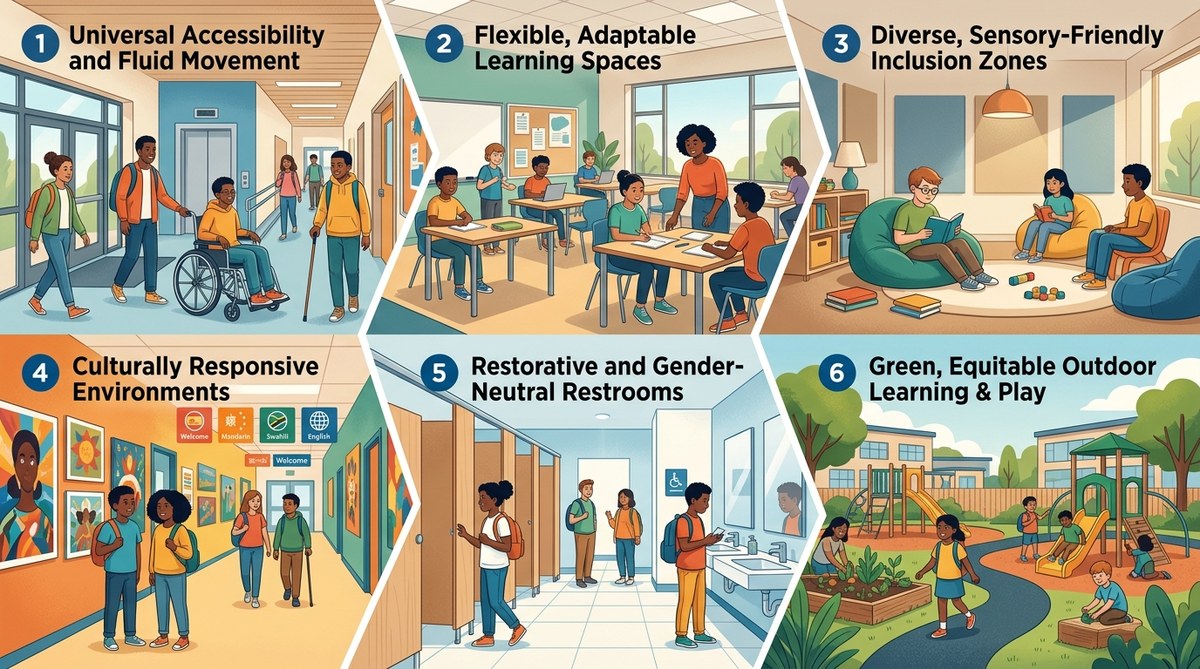
Also, consider how your physical school environment affects mental health. A building that is noisy, crowded, or poorly lit can increase stress. Our piece on the impact of school design on student well being and academic success offers practical ideas for creating calming spaces.
Looking Ahead: The Future of School Mental Health in 2026 and Beyond
The conversation around equitable access to mental health services for students is not going away. If anything, it is becoming more urgent. The federal government has increased funding for school based mental health services through the Bipartisan Safer Communities Act, and many states are passing laws that require a minimum ratio of counselors to students. But funding alone is not enough. We need a fundamental shift in how we think about student support.
In the coming years, we will likely see more schools adopting a “whole child” approach. This means integrating mental health into every part of the school day, from morning meetings to after school programs. It also means using technology to bridge gaps. Teletherapy platforms are becoming more common, and artificial intelligence tools can help screen for risk factors before a crisis occurs. However, technology must be used carefully to avoid creating new equity gaps. For more on this, check out our guide on how technology can bridge education gaps and promote equity in U.S. schools.
Your Next Step Toward a More Equitable School
You do not have to transform your entire system overnight. Start small. Pick one of the steps from the action plan above and implement it this semester. Talk to your students. Listen to their stories. Use what you learn to make one change that removes a barrier for someone.
The students who need equitable access to mental health services the most are often the ones who are least likely to ask for help. It is our job as educators, administrators, and policy makers to go find them. To meet them where they are. To build a system that does not wait for a student to hit a crisis before offering support.
When you do that, you are not just improving test scores. You are changing lives. And that is the most important outcome of all.