elias
elias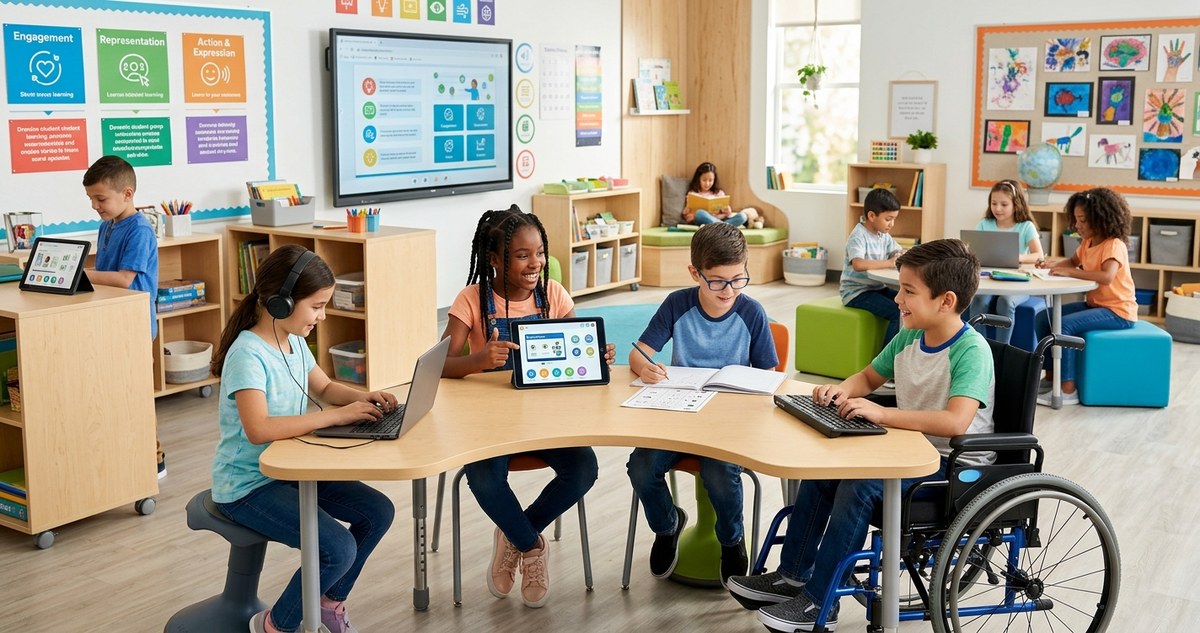
Every classroom holds a beautiful spectrum of learners. Some students thrive on reading a textbook chapter, while others need a video or a hands-on activity to truly grasp a concept. For years, we designed lessons for the “average” student, but that approach leaves too many learners behind. Universal Design for Learning (UDL) flips that script. It asks us to design our instruction from the start to be flexible, accessible, and engaging for everyone. This isn’t about lowering standards. It’s about removing the barriers that prevent students from showing what they know. In 2026, UDL is the most powerful framework we have for building classrooms where every student can succeed.
Universal Design for Learning is not a checklist or a one-time fix. It is a mindset that shifts focus from student deficits to curriculum barriers. By offering multiple means of representation, action and expression, and engagement, you create a classroom where variability is expected and supported. Start small, reflect often, and watch your students thrive.
The Three Pillars of UDL Explained
The UDL framework is built on three core principles, each grounded in neuroscience. Understanding these principles is the first step toward applying them.
Multiple Means of Representation (The “What” of Learning)
Students perceive and process information in different ways. Some need text, others need images, and some need both. Offering content in varied formats ensures that no single mode of delivery becomes a barrier.
Multiple Means of Action and Expression (The “How” of Learning)
Students also differ in how they navigate a learning environment and express what they know. A student with dysgraphia might struggle with a written essay but excel in an oral presentation. Providing options for expression allows all students to demonstrate their mastery.
Multiple Means of Engagement (The “Why” of Learning)
Motivation is personal. What sparks curiosity in one student might bore another. UDL asks you to build in choices, offer relevant challenges, and foster a community where students feel safe to take risks.
A Step-by-Step Process for Applying UDL
Moving from theory to practice can feel daunting. Here is a simple, repeatable process you can use to design or redesign any lesson.
- Identify the goal. What do you want every student to learn? Be specific and clear. A fuzzy goal leads to a fuzzy lesson.
- Analyze potential barriers. Look at your goal and think about what might get in the way. Is it the reading level of a text? The format of an assessment? The lack of student choice?
- Design for variability. Now, build in options using the three UDL principles. Offer the same content as a video, a podcast, and a written article. Let students choose to show their learning through a diagram, a skit, or a written report.
- Teach and observe. Deliver your lesson and watch how students interact with the options you provided. What is working? What is confusing?
- Reflect and adjust. After the lesson, ask yourself: Did all students meet the goal? What barriers remained? Use your observations to improve the lesson for next time.
Common UDL Mistakes and How to Fix Them
Even well-intentioned educators can fall into traps. The table below outlines common mistakes and their solutions.
| Common Mistake | Why It Happens | The UDL Fix |
|---|---|---|
| Offering choice without structure. | Teachers worry that too many options will overwhelm students. | Provide a clear framework for choice. For example, let students pick from three pre-approved project formats, each with a rubric. |
| Focusing only on technology. | It is easy to think UDL means “use more apps.” | Technology is a tool, not the goal. UDL is about pedagogy. Start with low-tech options like graphic organizers or flexible seating. |
| Applying UDL to one lesson, but not the unit. | It is easier to retrofit a single lesson than to plan a whole unit. | Map out an entire unit using the UDL framework. This ensures consistency and reduces last-minute scrambling. |
| Forgetting about engagement. | Representation and expression are more concrete, so they get more attention. | Intentionally design for engagement first. If students are not motivated, the other options do not matter. |
A Practical Example: Teaching the Water Cycle
Let’s see how this works in a real 5th-grade science classroom.
The Goal: Students will be able to explain the four main stages of the water cycle (evaporation, condensation, precipitation, collection).
Barriers:
– The textbook uses complex vocabulary.
– A traditional written test favors students with strong writing skills.
– A single lecture format does not appeal to kinesthetic learners.
UDL Design:
– Representation: Provide the textbook chapter, a short animated video, and a simple diagram with labels. Let students choose their entry point.
– Action and Expression: Offer three ways to show understanding. Option A: Draw and label a diagram. Option B: Act out the water cycle as a short skit. Option C: Record a two-minute audio explanation.
– Engagement: Let students choose to work alone, with a partner, or in a small group. Connect the lesson to a local weather event, like a recent rainstorm, to make it relevant.
“UDL is not about doing everything at once. It is about making one small change that removes a barrier for a student, and then building from there.” – Katie Novak, UDL and inclusive education consultant.
What UDL Is and What It Is Not
It is easy to misunderstand UDL. Let’s clear up some confusion.
- UDL is not a special education strategy. It is a general education framework that benefits all students, including those with disabilities.
- UDL is not a curriculum. It is a design process you apply to any curriculum.
- UDL is not about making things easier. It is about making learning accessible. The rigor stays the same; the path to the goal changes.
- UDL is not a one-time training. It is a continuous cycle of reflection and improvement.
Tools and Techniques to Get You Started
You do not need a massive budget to implement UDL. Here are some practical tools and techniques you can use tomorrow.
- Graphic organizers. Help students see relationships between ideas.
- Flexible seating. Allow students to choose where they learn best: a standing desk, a beanbag, or a traditional chair.
- Choice boards. Create a grid of activities. Students pick one from each row to complete a unit.
- Digital tools. Use text-to-speech, speech-to-text, and closed captioning on videos.
- Rubrics with clear criteria. Students need to know exactly what success looks like.
For more ideas on designing your classroom space, check out our guide on creating inclusive learning spaces that foster student engagement.
Making UDL a School-Wide Practice
Individual teachers can do amazing things, but UDL has the most impact when it is embraced by the whole school. A school-wide approach requires leadership support, ongoing professional development, and a culture that celebrates variability.
Start by building a small UDL team. This team can pilot strategies, share successes, and provide peer coaching. Over time, the entire faculty can shift from a “fix the student” mindset to a “fix the design” mindset.
If you are looking for more ways to support all learners, our article on strategies to promote inclusive education for all students offers additional ideas for building an equitable environment.
Your First Steps Toward a UDL Classroom
You do not need to redesign your entire curriculum overnight. That is a recipe for burnout. Instead, pick one lesson this week and apply the five-step process from earlier. Identify a single barrier and remove it. That is all it takes to start.
Next, choose one of the three UDL principles and focus on it for a month. Maybe you will focus on offering more options for engagement. Try adding a choice board to your next unit. See how your students respond.
Finally, share your journey with a colleague. Talk about what worked and what did not. UDL grows stronger when it is a conversation, not a solo mission.
Building a Truly Inclusive Classroom, One Small Change at a Time
The beauty of Universal Design for Learning is that it meets students where they are. It acknowledges that there is no such thing as a “typical” learner. By designing for variability from the start, you send a powerful message to every student: you belong here, and you can succeed.
Start small. Reflect often. Celebrate the wins, even the small ones. Your classroom will become a place where barriers fall away and learning truly takes flight. For more on creating supportive environments, read about the impact of school design on student well-being and academic success. The work you do today will shape the learners of tomorrow.